Category 1, 2, and 3 Water Damage Explained for North Fulton Homeowners
Need help with your own home?
Tell us your concern. We'll check local contractor availability.
No referral fee · No obligation to hire
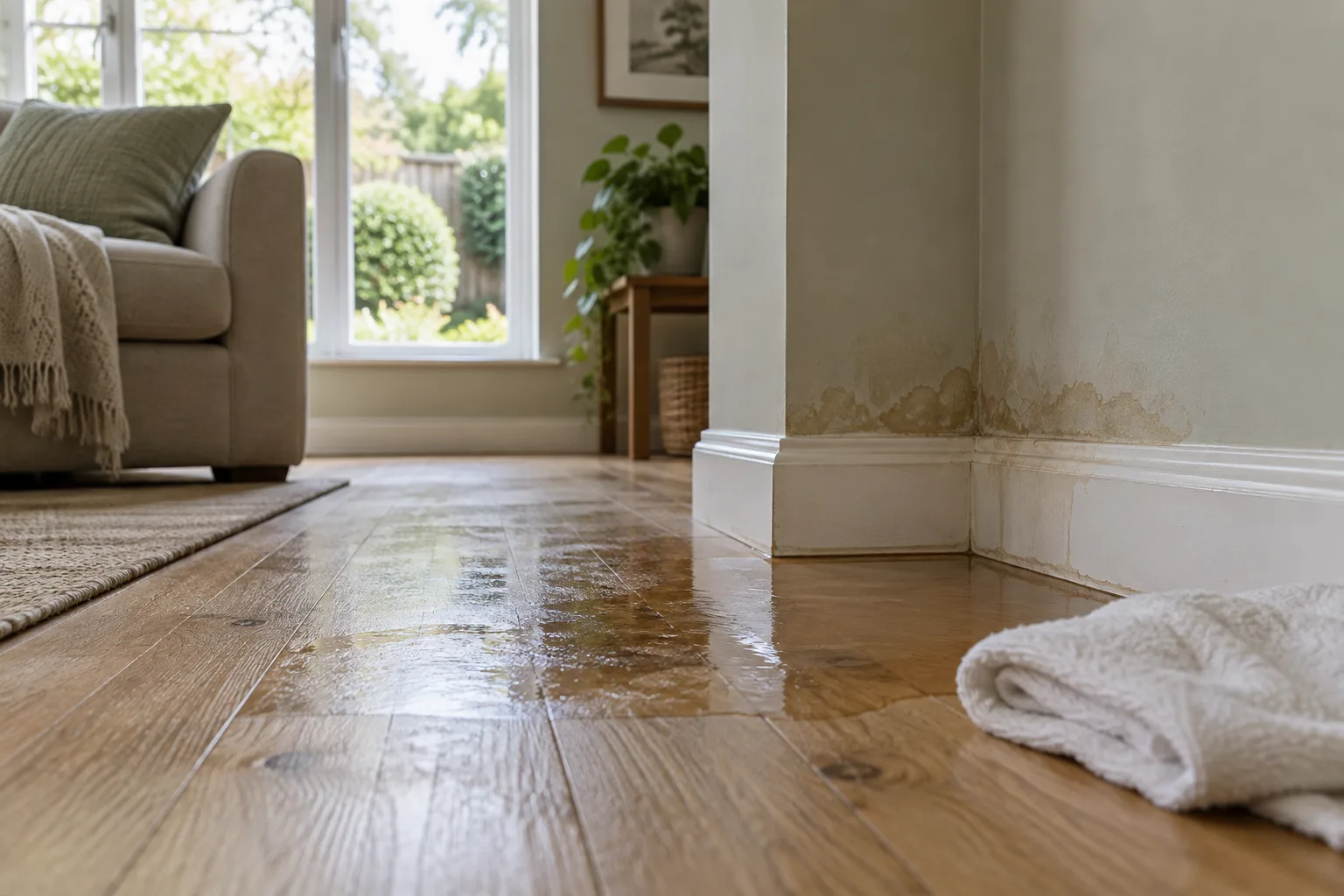
What do Category 1, 2, and 3 water damage mean?
Category 1, 2, and 3 are contamination grades defined by the IICRC S500 standard. Category 1 is clean water from a supply line, Category 2 is gray water with significant contamination, and Category 3 is black water carrying sewage or rising floodwater. The category determines safety precautions, what materials can be saved, and cost.
The categories come from the IICRC S500, the industry standard a professional water damage restorer follows. They grade the water's contamination level at its source: Category 1 comes from a sanitary supply, Category 2 carries contamination significant enough to sicken someone who drank it, and Category 3 is grossly contaminated black water that can carry pathogens. Every decision that follows on a job in Sandy Springs or Roswell, from protective gear to what gets thrown away, traces back to that grade.
Category is the first thing a trained restorer establishes during an inspection, because it sets the practical rules of the cleanup. Clean water can often be dried in place with air movers and dehumidification. Gray water requires disinfection and removal of some porous materials. Black water flips the job into demolition mode, where carpet, pad, drywall, and insulation that touched the water are cut out and disposed of rather than saved.
One distinction worth fixing in your head early: category measures how dirty the water is, while Class 1 through 4 measures how hard the structure will be to dry. A loss in a Dunwoody basement gets both labels, and together they predict the scope, the equipment, and the budget.
What is Category 1 water, and is it really safe?
Category 1 is water from a sanitary source: a burst supply line, a failed water heater inlet, a tub or sink overflow with no contaminants. It poses little immediate health risk, so wet carpet, pad, and drywall can often be dried in place, but only if drying starts quickly, because clean water degrades over time.
Category 1 losses start at a sanitary source: a burst copper or PEX supply line, a failed water heater inlet, a refrigerator ice maker line, or a bathtub left running. These are the most common water emergencies in North Fulton homes, and they are also the most forgiving, because the water itself carries no meaningful contamination when it escapes.
Forgiving does not mean harmless. Even clean water destroys what it soaks if it is not removed fast, so a contractor, if available, typically starts with water extraction, then sets air movers and dehumidifiers and verifies progress with a moisture meter until the structure reaches its drying goal. Caught quickly, carpet, pad, and much of the drywall can usually be dried in place rather than replaced.
The clean label also depends on what the water touched on the way down. Supply water that ran through a dirty crawl space, soaked old carpet, or sat for a day or two is no longer Category 1, which is why even a clean-looking loss deserves a professional assessment rather than a shop vac and a guess.
What is Category 2 gray water damage?
Category 2, or gray water, carries significant contamination that can cause illness if ingested. Common sources include washing machine and dishwasher discharge, aquarium leaks, and toilet overflows containing urine but no feces. Carpet pad usually must be removed, hard surfaces get cleaned and disinfected, and the area receives antimicrobial treatment before drying.
Gray water sits in the middle: contaminated enough to cause illness if ingested, but not raw sewage. Under IICRC S500 it demands a step up in handling, with cleaning and antimicrobial treatment of everything that stays, and removal of the porous materials that cannot be reliably disinfected, starting with carpet pad.
Most gray water losses in Johns Creek and Brookhaven homes come from appliances. The discharge side of a washing machine or dishwasher carries detergents, food residue, and microbial load, which is exactly why a failed drain hose is graded harder than a failed supply hose on the same machine.
- Washing machine discharge: drain hose failures and overflowing standpipes are classic Category 2 sources.
- Dishwasher discharge: food-laden water that backs up or leaks mid-cycle.
- Toilet overflows with urine but no feces: graded Category 2; anything worse becomes Category 3.
- Aquarium and waterbed leaks: biologically active water that has been sitting at room temperature.
- Condensate and minor sump seepage: HVAC condensate overflows and light sump pump seepage typically land here.
What makes Category 3 black water so dangerous?
Category 3 black water is grossly contaminated: sewage backups, toilet backflow, and rising floodwater from storms or the Chattahoochee River corridor. It can carry bacteria, viruses, and parasites, so porous materials it touches, like carpet, pad, drywall, and insulation, are removed and disposed of rather than dried in place.
Category 3 covers water that is grossly contaminated at the source: a sewage backup, toilet backflow originating beyond the trap, and any rising water that entered at ground level, including creek flooding along the Chattahoochee River corridor and runoff from the summer thunderstorm season that gives metro Atlanta roughly 50 inches of rain a year. Floodwater is automatically Category 3 no matter how clear it looks, because it picks up soil organisms, fertilizer, fuel residue, and whatever the storm drains were carrying.
Black water changes the protocol completely. A contractor's crew works in full protective equipment, isolates the area with containment and negative air pressure, and runs HEPA filtration so contaminated air does not migrate through the house. Porous materials the water touched, such as carpet, pad, drywall, insulation, and often subfloor, are removed and disposed of as contaminated waste, and every remaining surface is then cleaned and treated with antimicrobials. That is the standard scope of professional sewage cleanup, and a similar playbook applies to flood and storm damage cleanup.
Do not wade into black water to rescue belongings, especially in a flooded basement where outlets or appliances may be submerged. Households with children, older adults, or anyone immunocompromised should stay out of the affected area entirely until it has been professionally cleaned and disinfected.
What do Class 1, 2, 3, and 4 mean on a water damage report?
While category measures contamination, Class 1 through 4 measures how much water the wet materials will release during drying, called the evaporation load. Class 1 is minimal absorption, Class 2 wets a full room, Class 3 saturates walls and ceilings, and Class 4 involves bound water trapped in hardwood, plaster, or concrete.
Class answers a different question than category: not how dirty the water is, but how much water the structure absorbed and how hard it will fight evaporation. The restorer establishes the wet boundary with moisture mapping, a moisture meter, and often thermal imaging, then assigns a class that drives how many air movers and dehumidifiers the job needs and how long drying will take.
Class is why two losses with identical square footage can carry very different drying bills. A Class 2 carpet loss in a Roswell bedroom may dry in a few days, while a Class 4 loss with water bound in hardwood and plaster keeps dehumidification equipment running much longer, which matters because drying equipment is typically billed by the day on written estimates.
- Class 1: the least water, with minimal absorption; part of one room and mostly low-porosity surfaces.
- Class 2: a full room with wet carpet and pad, and water wicked up the walls less than about two feet.
- Class 3: the heaviest evaporation load; ceilings, walls, insulation, and floors saturated, often from water entering overhead.
- Class 4: bound water held inside dense materials like hardwood, plaster, brick, and concrete; requires specialty drying setups and longer timelines.
How does the water category change cleanup costs?
Higher categories cost more because contamination adds removal, disposal, and disinfection work. As labeled estimates for the Atlanta market, clean-water extraction typically runs $1,300 to $5,500 and structural drying $2,000 to $6,000, while Category 3 sewage cleanup runs $2,000 to $10,000. Actual pricing depends on an on-site inspection.
As labeled estimates for the Atlanta market, the progression looks like this: a Category 1 loss is often handled with water extraction, typically $1,300 to $5,500, plus structural drying, typically $2,000 to $6,000, while a Category 3 loss starts with sewage cleanup, typically $2,000 to $10,000, before any rebuild. A large black water loss that requires demolition and reconstruction can reach full-restoration territory, typically $3,000 to $30,000 or more as a labeled estimate. Most of the difference is the removal, disposal, and disinfection work that contamination forces; our breakdown of sewage backup cleanup costs goes deeper on the high end.
None of those figures is a quote. Actual pricing depends entirely on an on-site inspection, where a contractor confirms the category, maps the wet boundary, and itemizes the scope, and that inspection fees and written-estimate terms are set by a contractor anywhere in the North Fulton service area, from Sandy Springs to Alpharetta.
A word on who we are, because it matters when money is involved: North Fulton Water Damage Pros, operated by Stratum Relay LLC, is a disclosed marketing and referral service, not a contractor. We do not perform or price the work; we may introduce you to an available local restoration contractor. There is no fee to request the connection, and we may receive a referral fee if a contractor accepts an introduction. Call (678) 944-8612 to request an introduction; assessment terms are confirmed directly.
Can Category 1 water turn into Category 2 or 3 over time?
Yes. Water category degrades as water sits. Clean Category 1 water that soaks into carpet and subfloor for a day or two picks up contamination and is treated as Category 2, and longer stagnation with microbial growth can push it to Category 3. Time literally raises the contamination grade and the cost.
Yes, and this is the most practical thing to understand about the category system. The IICRC S500 treats category as dynamic: clean water that sits absorbs contamination from the materials it soaks, including carpet soil, subfloor adhesives, and wall cavities, and microbial activity ramps up fast in Georgia's humid subtropical climate. A burst supply line ignored over a long weekend in a Brookhaven crawl space is no longer a clean water loss when Monday comes.
Mold is the clock behind the degradation. It can begin developing within 24 to 48 hours of water exposure, and once growth takes hold, remediation under the IICRC S520 mold standard becomes its own project, typically $1,500 to $6,000 as a labeled estimate on top of the original water loss, with actual pricing set only after an on-site inspection. Our guide to how fast mold grows after water damage walks through that timeline hour by hour.
The takeaway is simple: the category you start with is not the category you will be billed for if the water sits. Fast extraction and drying lock a loss in at its cheapest, cleanest grade, which is why prompt action matters, and some contractors in this field offer response at any hour, but availability varies and must be confirmed directly across Fulton County.
Frequently asked questions
Who determines the water category after a loss?
The restorer who inspects the loss assigns the category under IICRC S500 based on the water source, what it traveled through, and how long it sat. Your insurance adjuster may review that designation during a claim, which is why photos of the source and a written inspection report are worth keeping for your proof of loss.
Is a toilet overflow Category 2 or Category 3 water?
It depends on what came up. An overflow of bowl water containing urine but no feces is generally graded Category 2. If the overflow contains feces, or the water backed up from beyond the toilet trap out of the sewer line, it is Category 3 and handled as black water regardless of how clean it looks.
Is rainwater from a roof leak considered clean Category 1 water?
Rarely in practice. Rainwater itself starts out fairly clean, but by the time it passes through roofing materials, attic insulation, and ceiling cavities it usually carries enough contamination to be treated as Category 2. Rising storm water entering at ground level is different: that is automatically Category 3, with no exceptions.
Does homeowners insurance treat Category 1, 2, and 3 losses differently?
Coverage usually turns on the cause, not the category: sudden and accidental discharges are commonly covered, gradual leaks are commonly excluded, and rising water falls under the standard flood exclusion, with NFIP flood insurance sold separately. Sewer backups often require their own endorsement. This is general information, not legal or insurance advice; your insurer and policy language make the final call.
Does North Fulton Water Damage Pros assess the water category itself?
No. We are a disclosed referral service, not a contractor, and we do not inspect, grade, or clean up water losses. We may introduce you to an available local restoration contractor who may perform the category assessment during an on-site inspection, and the homeowner pays nothing for the connection.
Can hard surfaces like tile and concrete be saved after Category 3 water?
Usually yes. Non-porous materials such as tile, sealed concrete, metal, and solid-surface counters can typically be cleaned and disinfected in place after black water exposure. It is the porous and semi-porous materials, including carpet, pad, drywall, insulation, particleboard, and unsealed wood, that generally must be removed and disposed of.