How Fast Does Mold Grow After Water Damage?
Need help with your own home?
Tell us your concern. We'll check local contractor availability.
No referral fee · No obligation to hire
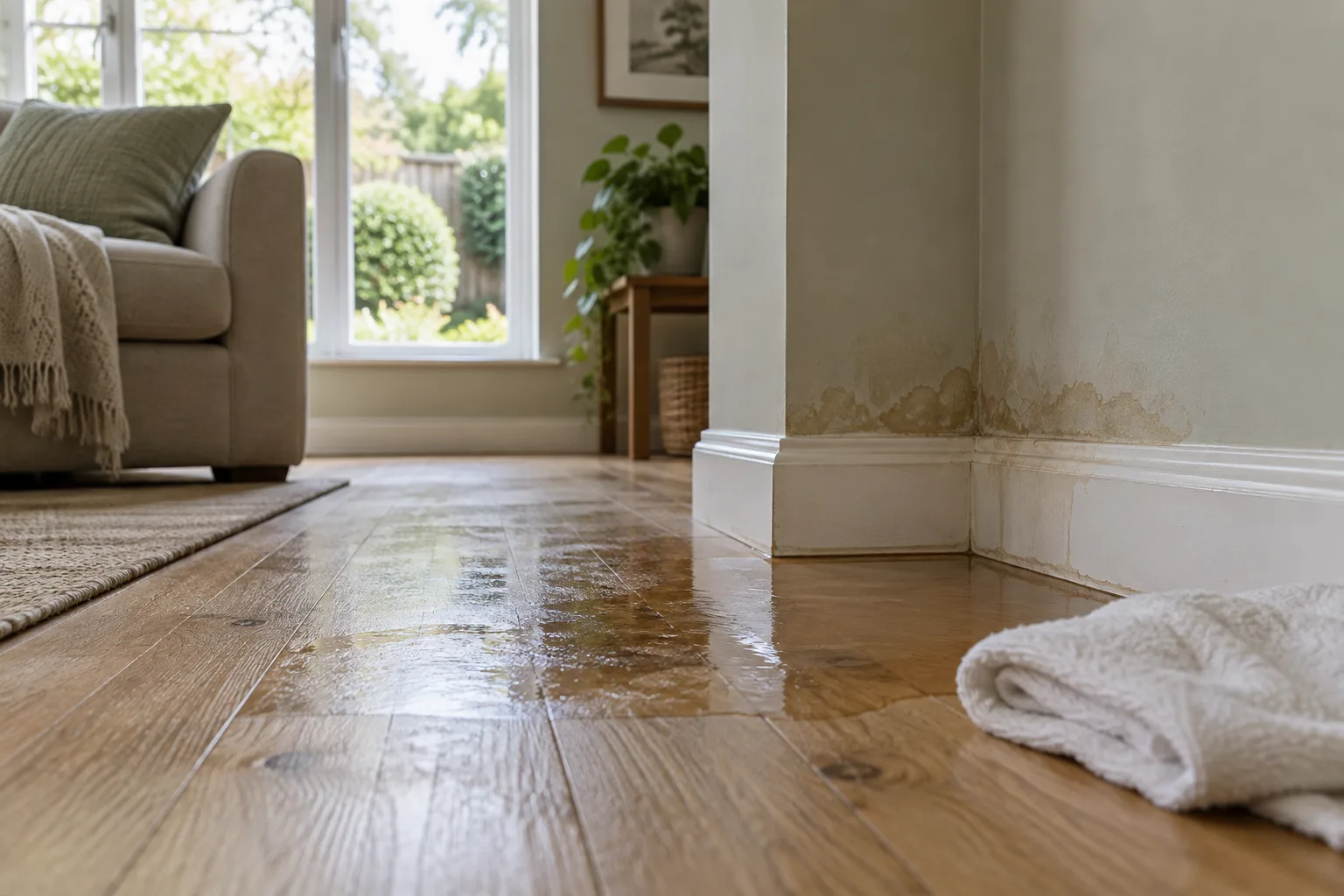
How fast does mold grow after water damage?
Mold can begin germinating within 24 to 48 hours of water exposure, and visible colonies often appear within a few days. Georgia's warm, humid climate speeds this up, so a wet basement or soaked drywall in Atlanta can start growing mold over a single weekend if it is not dried fast.
The widely cited rule of thumb is that mold can begin developing within 24 to 48 hours of water exposure. See EPA's mold and moisture guide for moisture-control guidance. That does not mean you will see a fuzzy patch in two days. It means microscopic spores, which are already floating in every home, start to germinate on wet surfaces once moisture, warmth, and a food source line up. From there, visible colonies usually follow within three to five days.
Speed is everything, which is why what you do first after water damage decides whether you face a quick dry-out or a mold problem. In North Fulton homes across Sandy Springs, Roswell, and Alpharetta, the clock starts the moment water touches drywall, carpet, or subfloor. A leak discovered Friday night and left until Monday has spent the entire germination window soaking.
What is the mold timeline hour by hour after a flood or leak?
In the first 24 hours materials soak and surfaces stay damp; between 24 and 48 hours mold spores germinate on wet organic materials; by days three to five colonies become visible and start to smell; after a week growth can spread across drywall, framing, and subfloor.
Think of mold growth as a sequence, not a switch. In the first 24 hours, porous materials like drywall paper, carpet pad, and insulation wick up water and stay saturated. Surfaces feel damp and the air gets humid, but you usually see nothing yet. This is the window where fast extraction and drying can prevent mold entirely.
Between 24 and 48 hours, dormant spores germinate on those wet organic materials. By day three to five, colonies become visible as black, green, or white patches and a musty smell sets in. After a week or more, growth can spread through wall cavities, behind baseboards, and into the subfloor, which is the point where simple drying no longer solves it.
What makes mold grow faster after water damage?
Three things accelerate mold: warmth, organic food sources, and poor airflow. Mold thrives between roughly 70 and 90 degrees, exactly Atlanta's indoor summer range. It feeds on drywall paper, wood, carpet, and insulation, and stagnant air in closed-up rooms or crawl spaces lets humidity linger so spores settle and multiply faster.
Warmth is the first accelerant. Mold grows fastest in the same temperatures people find comfortable, roughly 70 to 90 degrees, which describes most Atlanta homes for much of the year. The second is food: mold digests the cellulose in drywall paper, wood framing, subfloor, carpet, and paper-faced insulation, all of which are everywhere in a typical house.
The third accelerant is poor airflow and trapped humidity. A sealed-up room, a finished basement, or a crawl space with no ventilation holds moisture against materials for days. That is why structural drying with air movers and dehumidification matters so much: it attacks all three factors at once by pulling moisture out before spores can take hold.
- Warmth: mold accelerates around 70 to 90 degrees, typical of Atlanta interiors
- Organic food: drywall paper, wood, carpet, and insulation all feed mold
- Trapped humidity: closed rooms, finished basements, and crawl spaces hold dampness
- Standing water: the longer materials stay wet, the faster colonies establish
- Hidden moisture: water inside wall cavities or under flooring dries slowly and feeds growth
Why are Atlanta summers the worst-case scenario for mold growth?
Because heat and humidity stack the deck. Metro Atlanta averages roughly 50 inches of rain a year, and Georgia's humid subtropical summers keep indoor air damp even with the AC running. Add summer thunderstorm flooding and warm temperatures, and mold can hit the 24 to 48 hour window at full speed.
Georgia sits in a humid subtropical climate, and metro Atlanta averages roughly 50 inches of rain a year. In summer, daily thunderstorms and high outdoor humidity mean the air carries far more moisture, so wet materials dry slowly even with the air conditioning on. The same soaked carpet that might dry quickly in an arid climate stays damp long enough for mold to win.
The Chattahoochee River corridor and the many creeks running through Fulton County add localized flood risk during summer storms. Homes in Dunwoody, Johns Creek, and Brookhaven with finished basements are especially exposed, because below-grade space is cooler, darker, and slower to dry. When a summer storm pushes water into a basement, the 24 to 48 hour mold window can pass before a homeowner even notices the moisture.
What should I do within the 24 to 48 hour window to stop mold?
Act fast: stop the water source, remove standing water, and start drying immediately. Pull up wet carpet, move furniture, and run fans and a dehumidifier. The single biggest lever is professional extraction and structural drying within that window, because mold cannot germinate on materials that are dried out before 48 hours pass.
The priority order is simple: stop the water, remove the water, then dry everything thoroughly. Shut off the supply if a pipe or appliance failed, then get standing water out fast. A wet-vac, pulled-up carpet, and box fans help, but household equipment rarely moves enough moisture out of drywall and subfloor to beat the 48-hour clock on its own.
That is where professional water extraction and drying change the outcome. A local contractor, if one is available, uses truck-mounted extraction, air movers, commercial dehumidification, and moisture mapping with a moisture meter and thermal imaging to confirm materials are actually dry, not just dry to the touch. Drying to IICRC S500 standards inside the window is what prevents mold from ever starting.
- Stop the source: shut off water to the failed pipe, appliance, or fixture
- Remove standing water quickly with a wet-vac or pump before it spreads
- Pull up wet carpet and pad and move furniture off damp flooring
- Run fans and a dehumidifier to start drying right away
- Call for professional extraction and drying to beat the 24 to 48 hour window
When does drying alone stop mold, and when do I need remediation?
If materials are fully dried within 24 to 48 hours, drying alone usually prevents mold and remediation is unnecessary. Once colonies are visible, smell musty, or have grown inside porous materials like drywall and insulation, drying is no longer enough and professional mold remediation under IICRC S520 becomes necessary to remove the growth.
Drying alone is the goal whenever you catch water fast. If a professional dries the structure to a verified dry standard within 24 to 48 hours, mold typically never germinates, and you avoid mold remediation entirely. This is the cheapest, cleanest outcome, and it is exactly why response speed matters more than almost anything else after a leak or flood.
Remediation becomes necessary once mold has actually grown. Visible colonies, a persistent musty odor, or growth inside porous materials mean the spores have established, and simply drying the area will not remove them. At that point a professional remediator works to IICRC S520, using containment, negative air pressure, HEPA filtration, and antimicrobial treatment to remove the growth. As a labeled estimate for the Atlanta market, that work typically runs $1,500 to $6,000, and you can see the breakdown in mold remediation cost in North Fulton. Actual pricing depends on an on-site inspection.
Water category also affects the decision. Clean Category 1 water from a supply line is the best case, while Category 2 gray water or Category 3 black water from a sewage backup carries contamination that pushes a job toward removal and disposal regardless of timing. The faster the moisture is removed, the smaller the eventual problem.
How do I get water dried fast in North Fulton before mold sets in?
Contact an available drying or restoration provider promptly when water is still present. North Fulton Water Damage Pros is a referral service, not a contractor: we may introduce you to an available local contractor, but the form does not dispatch or guarantee a response. Call (678) 944-8612 to request an introduction and confirm scope, timing, and fees directly.
The fastest way to beat the mold clock is to contact an available professional drying provider now. Request a water damage assessment or call (678) 944-8612 for a referral; the form does not dispatch or guarantee a crew. Mold can start within 24–48 hours, so do not wait for a referral before addressing active water.
Homeowners in Sandy Springs, Roswell, Dunwoody, Alpharetta, Johns Creek or Brookhaven may request an introduction. We do not guarantee availability or response. The referral request has no fee from us; we may receive a referral fee if a contractor accepts. Confirm assessment fees and any written-estimate terms directly. We are not a contractor and do not perform remediation.
Frequently asked questions
Can mold grow inside walls where I cannot see it after a leak?
Yes, and that is common. Water wicks into wall cavities and behind baseboards, so mold can grow on the back of drywall and on framing while the visible surface looks fine. A musty smell with no obvious source is a classic sign. Moisture meters and thermal imaging can find the hidden dampness.
Does mold always grow after water damage, or only sometimes?
Not always. If materials dry completely within 24 to 48 hours, mold usually never starts. Mold needs sustained moisture, so a small spill wiped up quickly is low risk. The danger comes from water that soaks into porous materials and stays wet, which is common with hidden leaks and flooded basements in humid Georgia.
How long can drywall stay wet before it has to be replaced?
It depends on how saturated it is. Lightly dampened drywall dried within 24 to 48 hours can often be saved. Once drywall has wicked up water for several days, swelled, crumbled, or grown mold on the paper facing, it usually has to be cut out and replaced rather than dried in place.
Can mold grow in cold weather, or only during Atlanta summers?
It can grow year-round. Summer heat and humidity speed it up, but mold also grows in heated indoor air during a Georgia winter, just more slowly. A wet basement in January still develops mold; it may simply take a few extra days. Indoor temperature and trapped moisture matter more than the season outdoors.
Is mold from a clean water leak less of a problem than from sewage?
The mold risk is similar, but the cleanup differs. Clean Category 1 water from a supply line is straightforward to dry. Category 3 black water from a sewage backup carries bacteria and contamination, so affected porous materials are usually removed and disposed of rather than dried, and the area is treated regardless of how fast you act.
How quickly can a local contractor start drying my home?
Some contractors in this field offer emergency response at any hour, but availability varies and must be confirmed directly across North Fulton. Because mold can start within 24 to 48 hours, prompt action matters. Call (678) 944-8612 to request an introduction and start the inspection.